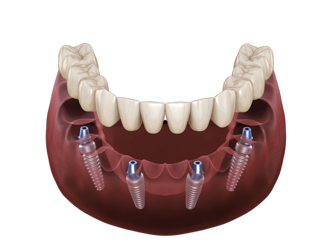
All-on-4 Dental Implants: The Complete Patient Guide
From candidacy and imaging to surgery, provisional teeth, healing and final restoration.
Read article →Clear, design-forward patient education on All-on-4 dental implants, All-on-X treatment, fixed full-arch bridges, “teeth in a day,” costs, recovery, materials and long-term maintenance.
Start with the topic closest to where you are now. Each guide is designed to answer the practical question first, then explain the details.
Learn how four implants can support a fixed full arch, who may be considered and what “same-day teeth” actually means.
Read the guide →Understand why “X” exists, when a different implant count may be planned and why more is not automatically better.
Compare options →See the line items that can change a full-arch quote, from surgery and sedation to provisional and final restorations.
Understand pricing →A practical timeline for swelling, food, work, hygiene, provisional teeth and the months-long integration process.
See the timeline →Good UX is about clarity. So is good treatment planning. This is the full-arch journey stripped down to the stages that matter.
The final result depends on what happens before surgery, during healing and when the definitive prosthesis is designed.
A same-day fixed bridge can be possible in selected cases, but the final prosthesis is typically delivered after healing.
See recovery detailsFour, five, six or another configuration can be considered depending on anatomy, bone, forces and restorative design.
Compare 4 vs 6All-on-4 is not simply “four screws and a bridge.” Full-arch treatment can involve imaging, remaining-tooth prognosis, bone distribution, implant position, bite forces, prosthetic space, hygiene access and restorative design.
Strategically positioned implants may support a complete upper or lower fixed prosthesis when the clinical conditions are appropriate.
A provisional fixed bridge may be possible around the day of surgery only when clinical criteria and implant stability are met.
After healing, the definitive restoration brings its own choices around material, contours, bite and long-term repairability.
All-on-4® is associated with Nobel Biocare. Implant count, angulation and restorative design must be individualized by a licensed clinician.
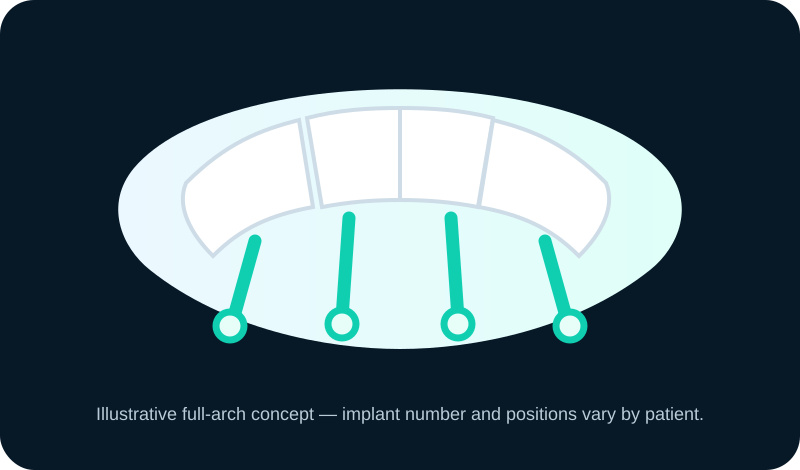
This table is a quick orientation tool, not a substitute for a treatment plan.
SmileCrafters provides dental implant and All-on-X services across four Ontario locations: Toronto, Hamilton, Ancaster and Brantford. Their patient information discusses full-arch planning, 3D imaging and implant-supported restorative options.
Partner disclosure: SmileCrafters is a featured client/provider on this site. Clinical suitability and treatment recommendations are determined by the treating dentist.
High-intent guides built around the questions people search before choosing full-arch implant treatment.
From candidacy and imaging to surgery, provisional teeth, healing and final restoration.
Read article →Four implants, six implants or another configuration: understand the logic behind the number.
Read article →A practical breakdown of the line items that can change an All-on-4 or All-on-X plan.
Read article →What healing often looks like, what varies and why integration outlasts the first week.
Read article →Fixed full-arch implant bridges and removable dentures solve the same problem differently.
Read article →Compare materials, repairs, wear and the questions to ask before the final prosthesis.
Read article →Educational answers only. A clinical exam and appropriate imaging are needed to determine candidacy.
All-on-4 is one specific full-arch concept using four implants to support a complete fixed arch. “Full-mouth dental implants” is broader and can describe several implant-based ways of rebuilding one or both arches.
All-on-X is a flexible term for a full-arch prosthesis supported by a clinician-selected number of implants. The “X” reflects that the implant count can vary with anatomy, bone quality, bite forces and restorative design.
Some patients can receive a temporary fixed prosthesis around the day implants are placed when the implants achieve adequate initial stability and the case meets the clinician’s criteria. The definitive prosthesis typically comes later.
No. Angled implant strategies can sometimes make better use of available bone, but grafting needs vary. Anatomy, bone loss and the chosen treatment plan can still make grafting or another approach appropriate.
Early soft-tissue recovery is measured in days to weeks, while bone integration develops over months. Diet, hygiene and loading may be modified during that period.
Bring your medical history, medications, existing dentures or dental records and a list of priorities. The right plan starts with diagnosis, not a preset number of implants.